Los Angeles Grasslands:
 |
| Regions of studied coastal sage. |
The current composition and condition of the California Grasslands historical perspective differ from every location. There is a difference between the past uncontrolled grazing practices and the use of managed grazing as a resource management tool. For millions of years, most of California’s grasslands were grazed and trampled by herbivores. Although efforts to restore native grasses to California’s grasslands are relatively recent, beginning with the conservation movement of 1970s, range scientists and agronomists have long been interested in improving California’s grasslands. The Los Angeles Basin in pre-historical times was dominated to a great extent by ligneous formations such as the chaparral and oak woodlands. In the last 50 years land use practices have changed; in some grazing areas there is less extensive and fire protection more effective. The patterns and processes involved in the vegetation mosaic in the Los Angeles Basin today are not unlike those in primeval times. The extent of grasslands have increased and the species composition have changed.

 |
| Our city has overtaken much of what used to be grasslands, attributing to the 99% decline in Los Angeles Grasslands. |
As you may have already figured out, the amount of grasslands in the Los Angeles county are very few and dissipating. It is very hard to still maintain natural wildlife due to the many humans that occupy California and especially the Los Angeles county. Due to the amount of agriculture, invasion of exotic species, and other human related activities such as construction, the grasslands of California have dwindled down by 99%. In addition high intensity farming practices, conversion of pastureland to cropland and over grazing, remove and degrade grassland habitat. Suppressing the natural cycle of fire, particularly near cities and towns, has expanded shrub and forest habitats at the expense of grasslands. This impact has made California grasslands one of the 21 most endangered ecosystems in the United States. Now as we focus in more on the Los Angeles area we find that the main “grasslands” that occupy L.A. are coastal prairies. Coastal Prairies covered 37 square miles that were rich in wildflowers and dotted with vernal pools. These grasslands were soon eliminated due to the humans building and developing L.A. as an urban part of California. We now have buildings, houses, factories, and businesses that occupy what was the beautiful grasslands. Due to this the bird population throughout the grasslands have severely diminished through the years. There has been a big drop due to the influence of human impact. The last coastal prairie that was left in the Los Angeles county was soon replaced with our well known Los Angeles International Airport, LAX, in the 1960’s. Due to the urbanization, not only were the grasslands completely removed, but they were also killed by the air pollution that was being injected into the air by all of the car exhaust, factory smog, and other urbanization side-effects. The humans have and had a great impact on this eco-system even though we did not intentionally try to kill off the grasslands and make them almost extinct, by us occupying L.A. we are slowly eliminating the natural wildlife.
 |
| We can assume due to this graph that the increase in population is a cause for the decrease in grasslands throughout Los Angeles. |
 |
| LAX has replaced what used to be Grasslands in Los Angeles |
 |
| How housing has led to a decrease in our grasslands |
Due to the dramatic decrease in California native grasslands, considering that about 99% of the grasslands in Los Angeles are extinct, there seems to be not much of a future for grasslands in Los Angeles. There has been many threats to grasslands which may include disturbance of clay soils by agricultural activities, invasion of exotic species, grazing, fire, and urban development. Some say that in order to save whats left to reseed grounds to maintain the grasslands and keep them living. But some studies have wondered whether it was needed to determine if fire or grazing was necessary to maintain or develop the grasslands. Because this system is not likely to present under current and future conditions, grasslands will continue to diminish due to the landowners using them for human use and the land not being preserved. Although there is some efforts to save grasslands, as mentioned in the next paragraph, the future and stability of this eco system as it is now is not looking good and may be short lived in Los Angeles.
 |
| Another way to conserve grasslands is to reduce medusa head grass to less than 15% of ground cover, we can do this by controllably burning it when the medusa grass is still green and everything else is dead around it. |
 |
| Reseeding can be a solution to not having to destroy grasslands due to urbanization. |
Since we humans have had such a great, mainly negative, impact on the grasslands we have tried to come up with some solutions to preserve the native wildlife. There were tests run on different types of grasses to figure out what grasses could withstand intense grazing and other human inflicted pains. A couple of objectives were finally put into action after many years of brainstorming and testing. The first is to reduce medusa head to less than 15% of the ground cover. This objective will work by burning a certain grass late in May when medusa head grass is still green and the other grasses are dry. All of these burns will be sure to made in accordance with the California Department of Forestry and Fire Protection. This is just one example of ways that we can try to salvage what little grasslands may be left. Another option would be to maybe reseed the grass instead of eliminating it entirely. When we may need to build a new high-rise tower or airport over a nice grassland, maybe instead of burning it, killing it, or removing it we can reseed it or plug plant it in another untouchable area that we may not need. There are ways in which we can try to improve this eco-system and not just let it disappear entirely but we need to take action and use other techniques like reseeding and plug planting.

The Diminishing Species Among Birds in Grasslands
48 species species nest in U.S. grasslands, including ducks, grouse, hawks, and songbirds.


Compared to other regions Grasslands suffer the most in diminishing bird species. Grasslands birds are among the fastest and most consistently declining birds in North America, including California; 48% are of conservation concern and 55% are showing significant declines.
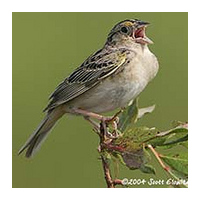 |
| declining bird species |
Works Cited:
"Habitat Conversion and Fragmentation." California's Coastal Prairies : Management. N.p., n.d. Web. 01 Dec. 2014.
"1000 HIKES 1000 DAYS by JEREMY JACOBUS." : Day 465: North Grasslands Trail / Las Virgenes Trail to De Anza Park. N.p., n.d. Web. 01 Dec. 2014.
"Hiking South Grassland Trail in Malibu Creek State Park." Examiner.com. N.p., n.d. Web. 01 Dec. 2014.
Porter, Eric E. "DENSITY, BIOMASS, AND DIVERSITY OF GRASSHOPPERS (ORTHOPTERA: ACRIDIDAE) IN A CALIFORNIA NATIVE GRASSLAND." The Great Basin Naturalist 56.2 (1996): 172-76. Web. 01 Dec. 2014.
"Four Winds 10 - News." The State of Our Nation's Birds Four Winds 10. N.p., n.d. Web. 01 Dec. 2014.
Carr, Kevin. "What Are the Impacts of Humans on Grassland Biomes? | The Classroom | Synonym." The Classroom. N.p., n.d. Web. 01 Dec. 2014.
Freudenberger, David O., Brian E. Fisher, and Jon E. Keeley. "Distribution and Stability of Grasslands in the Los Angeles Basin." Department of Biology. Southern California Academy of Sciences, 4 Dec. 1985. Web.
"Grasslands." National Geographic. National Geographic Society, 1996. Web.
Henwood, William D. "Grassland Protected Areas." Protected Areas Programme Parks. 3rd ed. Vol. 8. October: n.p., 1998. 1-15. Print.
USDA Agricultural Research Service. "Global Warming May Lower Grassland Quality." ScienceDaily. ScienceDaily, 1 June 2007.
08, August. "No Way to Build a Community." Los Angeles Times. Los Angeles Times, 08 Aug. 1999. Web. 01 Dec. 2014.
08, August. "No Way to Build a Community." Los Angeles Times. Los Angeles Times, 08 Aug. 1999. Web. 01 Dec. 2014.
